|
Reference: Hunter's Allen |
|
Hunter's Allen
*First printed in Tennessee
Walking Horse Magazine, 1945
by
Burt Hunter
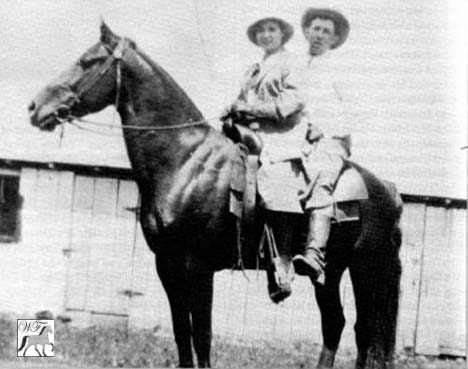
 I appreciate the opportunity of telling the story of my sorrel
stallion, Hunter's Allen F-10 that we called Little Allen. I
rode him for many years and he was just as supple, with as
quick an ear and the same gait as when a three, four or five
year old. At the age of 16 to 20, he was as grand a saddle
horse as ever lived, regardless of his years. Little Allen is
a family tradition, appreciating as we did the great foals
that he gave to the Tennessee Walking Horse world, and we
point with pride the fact that in the first two volumes of the
Tennessee Walking Horse Stud Books, through his numerous
progeny, his name is comparable with any sire.
The great mares that were sired
by Little Allen were no disappointment to their owners, as
they, in turn, produced performers of great ability and value,
and they were highly appraised by all judges. We call
attention to the fact that champion Midnight Sun, the first
stallion ever to win the World Grand Championship at the
Tennessee Walking Horse National Celebration, is a great
grandson, through his dam, by Dement's Allen, by Hunter's
Allen F-10.
In advanced years, there was not
a pimple or blemish that could be found on this great stallion
and no horse ever lived that traveled thousands of miles,
under saddle with a better foot or set of limbs. I never knew
him to stumble or even tip his toe. He had the wind of a fox
and he could actually walk around eight miles an hour in
perfect form. His canter was perfect with a flat foot walk
that was straight and fast.
At the time we purchased Hunter's
Allen F-10, he was called Allen II, Little Allen and Walker's
Allen.
He made his first show at the
Tennessee State Fair in 1912, winning the class for the best
Walking Stallion, any age. He repeated this performance in the
same class in 1913. In 1916 he won the Stallion Class and then
came back to win the Walking Horse Championship, Stallion,
Mare or Gelding. He won the Stallion Class again in 1917 at
the Tennessee State Fair. He was not shown again until 1924
(at 18 years of age) when he won the Stallion Class again at
the State Fair. He won, all told, the Stallion Classes at this
last court of resort five times.
In 1926, at the age of 20, Fred
Walker, who had trained and shown Hunter's Allen F-10 in his
younger years, wanted to show him again at the Bedford County
Fair, Shelbyville, Tennessee. There he defeated his famous
show son, Brown Allen, a recognized stallion of today, also
Bud Allen, who was rated among the best. It seemed the old
show horse realized he must show up the young tribe and
especially his son, brown Allen in a contest that the "old
timers" still recall as one of the greatest stallion classes
ever witnessed.
His get left a great record in
show performances, his sons and daughters winning a the
Tennessee State Fair, including the Tennessee Walking Horse
Stake in 1920, 1921, 1922, 1925, 1927, 1928, 1929, 1932 and
1933. This achievement has not been surpassed by any living
stallion.
He sired the famous show mare,
Mary Allen, owned and shown by Z.R. Pickens, Bell Buckle,
Tennessee. She won both the Junior and Senior Stakes,
Tennessee State Fair. He also sired the famous mare, Queen,
owned by Dr. R.B. Berry, Lewisburg, Tennessee, who won the
Junior Stake, and was a full sister to Mary Allen. He was the
sire of the grand old mare that passed away this year (1945),
Old Hunter, owned and developed by Ed Jones, Lewisburg,
Tennessee, also winner of the Junior Stake. One of his famous
daughters, Lady Turner, 26 years of age in 1945, was the first
mare that ever defeated the renowned performer,
Merry Legs F-4.
Other outstanding daughters of the old sire must include the
great mare Springtime, owned by Z.R. Pickens, Bell Buckle. She
was undefeated in open classes or stakes at all shows for one
season. At the close of the show season she was sold to a new
owner in New York, topping all known prices at the time of her
sale. She was a full sister to Orr's Hal Allen, owned by
Newton Orr, Farmington, Tennessee and he also made many shows
as a three and four year old.
Perhaps the most outstanding son
of Hutner's allen F-10 as a show stallion was
Brown Allen, who
was owned and shown by J.F. Womack of Flat Creek, Tennessee;
he was campaigned throughout Middle Tennessee by Fred Walker,
winning Stallion and Gelding classes and many stakes, showing
one entire season without defeat.
Mary Allen, daughter of Hunter's
allen developed into a great broodmare, producing Greater
Glory by Wilson's allen, the Junior Champion Stake winner at
the Shelbyville Celebration in 1941. owned and shown by Col
J.H. Haynes, Springhill, Tennessee.
The late A.M. Dement, owner and
breeder of the celebrated mare
Merry Legs F-4,
bred her to Hunter's allen F-10 and produced the proven sire,
Last Chance,
who was also one of the greatest two-year-old stallions of his
time and was successfully shown throughout the season by the
late Floyd Carothers. Mr. Dement stated to me that he believed
Merry Legs
crossed better with Hunter's Allen F-10 than with any stallion
she was ever bred to. Two of the foals by Hunter's Allen F-10,
out of
Merry Legs
died as yearlings. Last Chance is also a producer of top
walking and show horses including Tommy Tell, undefeated two
year old, and there were other sons and daughters of equal
importance. The records of the TWHBA disclose a total of 49
registered stallion offspring of Hunter's Allen foaled up to
1933 with many others being recorded since that year.
Another great producing matron by
Hunter's Allen F-10 was Ella II, dam of
Hall Allen;
also Minnie Black, the dam of the famous mare
Maude Gray, one
of the recognized all-time producing mares of the breed.
Another famous granddaughter is Lynnie Gray, by Neal's Allen,
out of
Maude Gray.
She was Grand Champion Stake winner at the Tennessee State
Fair, 1938, also winner the same year of the Junior and Senior
Stake at the Kentucky State Fair.
Allow me to refer to Hunter's
Allen's breeding ability for reproducing the perfect gaits of
the Tennessee Walking Horse; meaning from young foals to
those fully matured. The winner of the first Futurity, held at
the Tennessee State Fair, was a weanling filly shown by Jim
Farrar, out of a Hunter's Allen F-10 mare. Dr. W.F. Fessey won
the Futurity Championship with a filly out of Mary Lou, by
Hunter's Allen F-10. His great-grandson, Arkansas rambler is
by Neal's Allen, and Tennessee Rambler by
Brown Allen, a
grandson, were outstanding performers in Mississippi, West
Tennessee, Arkansas and Missouri.
Hato Benito by Milky Way Allen by
Golden Sunshine
with the dam Nell Hightower, a Hunter's Allen mare, was
shipped to Puerto Rico as a walking two year old as head stud
on a large sugar plantation with 400 horses under saddle every
day. He was the first Tennessee Walking Horse exported after
the TWHBA was organized.
Through public and private sales,
the blood of Hunter's allen F-1- has been distributed wherever
the Tennessee Walking Horse had gone, including many of his
famous sons and equally-as-good daughters. They have found
their way into some of the greatest bands of brood matrons and
stallions in the country. They are highly appraised today by
small and large breeders everywhere.
The get of Hunter's Allen F-10
have been in continuous demand since his death, January 15,
1932, by breeders who saw the prepotency of the old stallion
and the fact that he could produce the true gaits of the
Tennessee Walking Horse. His career as a show horse of top
rank and perhaps on of the greatest all-time pleasure mounts
of the breed, with abundant stamina and gameness, carried him
successfully through long years of active service,
participating in the best shows of the day and winning his
last championship when 20 years of age at Shelbyville. No
other stallion of the breed can surpass his years of
usefulness, and when he passed away, his conformation was that
of a horse not over eight or nine, unblemished, with all the
gameness he possessed as a youngster.
I believe the records will
sustain me in the statement that only two sons of the renowned
allen F-1 have ever shown male progeny in the Stud Books of
the TWHBA. They are Hunter's Allen F-10 and
Roan Allen
F-38. There are several outstanding producing mares by Allan
F-1 that show progeny in the first and second volumes. Of
course, they are further removed at this time.
Yes, we are proud of the record
of Hunter's Allen F-10 and the good name that he has helped to
mold, with his blood passing on for the benefit of the
Tennessee Walking Horse tribe. Those who seek and know the
Tennessee Walking Horse as we how have them developed, can
appreciate, I hope, the contribution that this great stallion
has made.
Let me wish for the entire
fraternity who love, own, show and develop the Tennessee
Walking Horse every success as breeders. In the years to come,
we hope, in turning the pages of breed history, they will
reflect on the achievements and progeny this great sire of the
breed has left for all.
I appreciate the opportunity of telling the story of my sorrel
stallion, Hunter's Allen F-10 that we called Little Allen. I
rode him for many years and he was just as supple, with as
quick an ear and the same gait as when a three, four or five
year old. At the age of 16 to 20, he was as grand a saddle
horse as ever lived, regardless of his years. Little Allen is
a family tradition, appreciating as we did the great foals
that he gave to the Tennessee Walking Horse world, and we
point with pride the fact that in the first two volumes of the
Tennessee Walking Horse Stud Books, through his numerous
progeny, his name is comparable with any sire.
The great mares that were sired
by Little Allen were no disappointment to their owners, as
they, in turn, produced performers of great ability and value,
and they were highly appraised by all judges. We call
attention to the fact that champion Midnight Sun, the first
stallion ever to win the World Grand Championship at the
Tennessee Walking Horse National Celebration, is a great
grandson, through his dam, by Dement's Allen, by Hunter's
Allen F-10.
In advanced years, there was not
a pimple or blemish that could be found on this great stallion
and no horse ever lived that traveled thousands of miles,
under saddle with a better foot or set of limbs. I never knew
him to stumble or even tip his toe. He had the wind of a fox
and he could actually walk around eight miles an hour in
perfect form. His canter was perfect with a flat foot walk
that was straight and fast.
At the time we purchased Hunter's
Allen F-10, he was called Allen II, Little Allen and Walker's
Allen.
He made his first show at the
Tennessee State Fair in 1912, winning the class for the best
Walking Stallion, any age. He repeated this performance in the
same class in 1913. In 1916 he won the Stallion Class and then
came back to win the Walking Horse Championship, Stallion,
Mare or Gelding. He won the Stallion Class again in 1917 at
the Tennessee State Fair. He was not shown again until 1924
(at 18 years of age) when he won the Stallion Class again at
the State Fair. He won, all told, the Stallion Classes at this
last court of resort five times.
In 1926, at the age of 20, Fred
Walker, who had trained and shown Hunter's Allen F-10 in his
younger years, wanted to show him again at the Bedford County
Fair, Shelbyville, Tennessee. There he defeated his famous
show son, Brown Allen, a recognized stallion of today, also
Bud Allen, who was rated among the best. It seemed the old
show horse realized he must show up the young tribe and
especially his son, brown Allen in a contest that the "old
timers" still recall as one of the greatest stallion classes
ever witnessed.
His get left a great record in
show performances, his sons and daughters winning a the
Tennessee State Fair, including the Tennessee Walking Horse
Stake in 1920, 1921, 1922, 1925, 1927, 1928, 1929, 1932 and
1933. This achievement has not been surpassed by any living
stallion.
He sired the famous show mare,
Mary Allen, owned and shown by Z.R. Pickens, Bell Buckle,
Tennessee. She won both the Junior and Senior Stakes,
Tennessee State Fair. He also sired the famous mare, Queen,
owned by Dr. R.B. Berry, Lewisburg, Tennessee, who won the
Junior Stake, and was a full sister to Mary Allen. He was the
sire of the grand old mare that passed away this year (1945),
Old Hunter, owned and developed by Ed Jones, Lewisburg,
Tennessee, also winner of the Junior Stake. One of his famous
daughters, Lady Turner, 26 years of age in 1945, was the first
mare that ever defeated the renowned performer,
Merry Legs F-4.
Other outstanding daughters of the old sire must include the
great mare Springtime, owned by Z.R. Pickens, Bell Buckle. She
was undefeated in open classes or stakes at all shows for one
season. At the close of the show season she was sold to a new
owner in New York, topping all known prices at the time of her
sale. She was a full sister to Orr's Hal Allen, owned by
Newton Orr, Farmington, Tennessee and he also made many shows
as a three and four year old.
Perhaps the most outstanding son
of Hutner's allen F-10 as a show stallion was
Brown Allen, who
was owned and shown by J.F. Womack of Flat Creek, Tennessee;
he was campaigned throughout Middle Tennessee by Fred Walker,
winning Stallion and Gelding classes and many stakes, showing
one entire season without defeat.
Mary Allen, daughter of Hunter's
allen developed into a great broodmare, producing Greater
Glory by Wilson's allen, the Junior Champion Stake winner at
the Shelbyville Celebration in 1941. owned and shown by Col
J.H. Haynes, Springhill, Tennessee.
The late A.M. Dement, owner and
breeder of the celebrated mare
Merry Legs F-4,
bred her to Hunter's allen F-10 and produced the proven sire,
Last Chance,
who was also one of the greatest two-year-old stallions of his
time and was successfully shown throughout the season by the
late Floyd Carothers. Mr. Dement stated to me that he believed
Merry Legs
crossed better with Hunter's Allen F-10 than with any stallion
she was ever bred to. Two of the foals by Hunter's Allen F-10,
out of
Merry Legs
died as yearlings. Last Chance is also a producer of top
walking and show horses including Tommy Tell, undefeated two
year old, and there were other sons and daughters of equal
importance. The records of the TWHBA disclose a total of 49
registered stallion offspring of Hunter's Allen foaled up to
1933 with many others being recorded since that year.
Another great producing matron by
Hunter's Allen F-10 was Ella II, dam of
Hall Allen;
also Minnie Black, the dam of the famous mare
Maude Gray, one
of the recognized all-time producing mares of the breed.
Another famous granddaughter is Lynnie Gray, by Neal's Allen,
out of
Maude Gray.
She was Grand Champion Stake winner at the Tennessee State
Fair, 1938, also winner the same year of the Junior and Senior
Stake at the Kentucky State Fair.
Allow me to refer to Hunter's
Allen's breeding ability for reproducing the perfect gaits of
the Tennessee Walking Horse; meaning from young foals to
those fully matured. The winner of the first Futurity, held at
the Tennessee State Fair, was a weanling filly shown by Jim
Farrar, out of a Hunter's Allen F-10 mare. Dr. W.F. Fessey won
the Futurity Championship with a filly out of Mary Lou, by
Hunter's Allen F-10. His great-grandson, Arkansas rambler is
by Neal's Allen, and Tennessee Rambler by
Brown Allen, a
grandson, were outstanding performers in Mississippi, West
Tennessee, Arkansas and Missouri.
Hato Benito by Milky Way Allen by
Golden Sunshine
with the dam Nell Hightower, a Hunter's Allen mare, was
shipped to Puerto Rico as a walking two year old as head stud
on a large sugar plantation with 400 horses under saddle every
day. He was the first Tennessee Walking Horse exported after
the TWHBA was organized.
Through public and private sales,
the blood of Hunter's allen F-1- has been distributed wherever
the Tennessee Walking Horse had gone, including many of his
famous sons and equally-as-good daughters. They have found
their way into some of the greatest bands of brood matrons and
stallions in the country. They are highly appraised today by
small and large breeders everywhere.
The get of Hunter's Allen F-10
have been in continuous demand since his death, January 15,
1932, by breeders who saw the prepotency of the old stallion
and the fact that he could produce the true gaits of the
Tennessee Walking Horse. His career as a show horse of top
rank and perhaps on of the greatest all-time pleasure mounts
of the breed, with abundant stamina and gameness, carried him
successfully through long years of active service,
participating in the best shows of the day and winning his
last championship when 20 years of age at Shelbyville. No
other stallion of the breed can surpass his years of
usefulness, and when he passed away, his conformation was that
of a horse not over eight or nine, unblemished, with all the
gameness he possessed as a youngster.
I believe the records will
sustain me in the statement that only two sons of the renowned
allen F-1 have ever shown male progeny in the Stud Books of
the TWHBA. They are Hunter's Allen F-10 and
Roan Allen
F-38. There are several outstanding producing mares by Allan
F-1 that show progeny in the first and second volumes. Of
course, they are further removed at this time.
Yes, we are proud of the record
of Hunter's Allen F-10 and the good name that he has helped to
mold, with his blood passing on for the benefit of the
Tennessee Walking Horse tribe. Those who seek and know the
Tennessee Walking Horse as we how have them developed, can
appreciate, I hope, the contribution that this great stallion
has made.
Let me wish for the entire
fraternity who love, own, show and develop the Tennessee
Walking Horse every success as breeders. In the years to come,
we hope, in turning the pages of breed history, they will
reflect on the achievements and progeny this great sire of the
breed has left for all.
|

|
Hunter's Allen
from the TWH Heritage Society
 Hunter's
Allen was foaled in 1909 and was owned by J.N. Black of Beech
Grove, Tennessee. He was the man who had also bred the
famous Maude Gray. Hunter's Allen was a golden sorrel horse with a
star and snip, long mane that was always wavy in appearance. His
long tail touched the ground. Hunter's
Allen was foaled in 1909 and was owned by J.N. Black of Beech
Grove, Tennessee. He was the man who had also bred the
famous Maude Gray. Hunter's Allen was a golden sorrel horse with a
star and snip, long mane that was always wavy in appearance. His
long tail touched the ground.
Hunter's Allen's influence on the Walking
Horse breed became buried in the female line of registration
papers. He was sired by Allan F-1 and his
dam was Allis, by Pat. Allis was owned by Dr. J.E. Childress
who lived in Coffee County. Dr. Childress used Allis to make
the rounds of his medical practice in that county. Many of the
homes he serviced were inaccessible except by horseback. Allis was
unusually tall at 16 hands, and was described as being "well made,
strong and good looking."
Hunter's Allen had several names, and the
first of these was Little Allen. He was used as a buggy horse when
he was old enough to work. He was driven alongside a pony
and used to deliver groceries. he was sold in 1917 to the Hunter
family who renamed him Hunter's Allen. He remained the Hunter's
horse until he died in 1932.
Hunter's Allen began his show career with
county fairs in Middle Tennessee. He was shown in 1912 at the
Tennessee State Fair and won first place. The following year, he
returned to the State Fair again and won first place, defeating
Roan Allen. A lot of old-timers spent
time debating which of these two horses was the better horse but
there was one aspect of them that proves interesting down to
this day: At the time these two horses were alive, crooked
or "sickle hocks", a trait that is often seen in modern day
Walking Horses, were frowned upon. Hunter's Allen was believed to
be the better horse for the simple reason that he did not have
crooked legs.
|
HUNTER'S ALLEN
TWHBEA #F-10
FOALED: 1906
DIED:
COLOR: CHESTNUT
MARKINGS:
OFF HIND STOCKING, STAR.
HEIGHT: 15.1h |
ALLAN
TWHBEA #F-1
COLOR: BLACK
 |
ALLANDORF
TWHBEA #12205
COLOR: GREY |
ONWARD
(STANDARDBRED)
B. 1875
ATR 1411 |
ALMA MATER
(STANDARDBRED)
B. 1872 |
MAGGIE
MARSHALL
TWHBEA #12206
COLOR: BLACK |
BRADFORD'S TELEGRAPH
(MORGAN)
B.1849 |
| UNKNOWN |
ALLIS
TWHBEA #84
COLOR: BLACK
MARKINGS: BOTH HIND
STOCKINGS, STRIP.
HEIGHT: 16H |
*PAT
TWHBEA #11266
COLOR: BLACK |
CUNNINGHAM'S
COPPERBOTTOM |
| UNKNOWN |
**NELL
TWHBEA #11202
COLOR: BLACK |
MOUNTAIN SLASHER
F-59 |
| UNKNOWN |
NOTABLE OFFSPRING
Hunter's Allen has 215 offspring registered with
the TWHBEA.
|