|
The Foundation
Sire: Roan Allen F-38
By
J.R. Brantley in collaboration with
J.J. Murray and Rachel Hosey
PEDIGREE
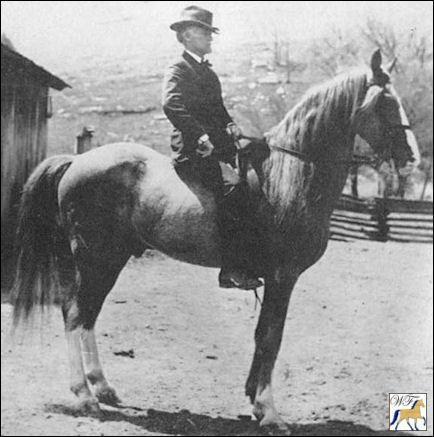 Roan horse; both hind stockings, fore
socks, broad strip; foaled May 23, 1906, died August, 1930; bred
and owned by J.R. Brantley, Manchester, Tennessee Roan horse; both hind stockings, fore
socks, broad strip; foaled May 23, 1906, died August, 1930; bred
and owned by J.R. Brantley, Manchester, Tennessee
SIRE:
Allan F-1, by
Allandorf, by Onward by George Wilkes F-54; Onward's dam Dolly, by
Mambrino Chief; Dolly's dam by Potomac; Allandorf's dam Alma
Mater, by Mambrino Patchen by Mambrino Chief; Mambrino Chief's dam
Lady Thorne; Alma Mater's dam Estella, by Imported Australian;
Allan F-1's dam, Maggie Marshall, by Bradford's Telegraph, by
Black Hawk, by Sherman Morgan.
DAM:
Gertrude, by Jacob's Royal Denmark, by
Artist, by King William, by Washington Denmark; Artist's dam,
Lucy, by Brinkers Drennon; King William's dam, Queen, by Balled
Stockings; Gertrude's dam Ball II, by Bullet (great grandson of
Gifford Morgan); Ball II's dam, Ball by Earnheart's Brook's F-25,
by Brooks, F-24, by Brown Pilot by Pacing Pilot (Canadian Pacer),
Dam of Earnheart's Brooks F-25, is said to be by McMeen's
Traveler. In Bedford and Marshall Counties, Tennessee. Earnheart's
Brooks F-25 contributed as many natural-gaited walking horses in
his day as any stallion. Black Hawk (5) is of strong Narragansett
blood through his pacer dam and shows in nearly all of the best
saddle horses of today. A progenitor of noted harness and saddle
horses.
Allandorf was the same acme of fashionable
harness breeding of his day. Mambrino Patchen, a proven sire
producing brood mares, sire of Mambrino King, said to be the most
handsome harness stallion that ever lived, favorable compared with
Montrose (106). In addition, the blood of Hambletonian (10) and
Henry Clay is infused into the blood of Allan F-1.
Bullet F-65, the sire of the second dam
produced many great show horses, including Frank Bullet that won
at the Tennessee State Fair.
The above pedigree blends a notable list
in standard bred gaited and walking horses.
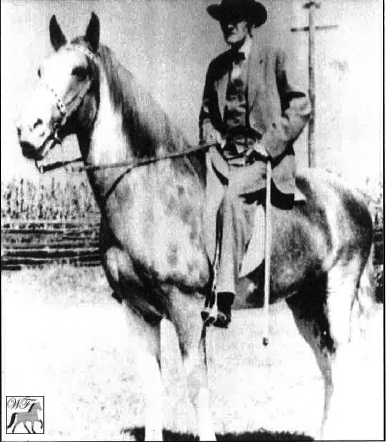 EDITOR'S NOTE:
James R. Brantley is an octogenarian,
having reached his eight-third birthday on January 27, 1945. He
was the breeder and developer of Roan Allen F-38, the foundation
sire presented in the accompanying article. Mr. Brantley reads two
daily papers, several magazines and local county papers. His son,
French, now County Court Clerk of Coffee County and president of
the Tennessee Walking Horse Breeders' Association of America, took
part in all discussions with his father and everyone enjoyed the
many memories Mr. Brantley had of Roan Allen. EDITOR'S NOTE:
James R. Brantley is an octogenarian,
having reached his eight-third birthday on January 27, 1945. He
was the breeder and developer of Roan Allen F-38, the foundation
sire presented in the accompanying article. Mr. Brantley reads two
daily papers, several magazines and local county papers. His son,
French, now County Court Clerk of Coffee County and president of
the Tennessee Walking Horse Breeders' Association of America, took
part in all discussions with his father and everyone enjoyed the
many memories Mr. Brantley had of Roan Allen.
It has always been my first rule in
appraising horses to know the individual as a colt if possible. In
the case of Roan Allen, no finer colt could be painted by the most
imaginative artist. As he was as a colt, so he was as a mature
horse; possessing rare quality in conformation, a very long and
finely proportioned neck, sloping shoulders, perfect head, quick
sharp ears, short back, very heavy flaxen mane, water-sprout
flaxen tail, rear stockings, fore socks, and broad blaze face, and
carried his head high.
My first memory of him was when he was
only a few hours old, and like all colts, gazing into a world
truly new. He was constantly looking in every direction, ears
erect, with playful glee, around his dam, Gertrude. Frankly, the
looks and pride of this little fellow had impressed me very much,
and I was indeed happy with his general appearance, and tried to
visualize him as a horse. My real thrill came as he gamboled
around his mother, showing a burst of speed, with a long
over-reach, nodding head with coltish legs beating in perfect form
a true running walk. This is why I repeat again, "as he was as a
colt, so he was as a mature horse."
The development of Roan Allen was the same
as our other colts, including young mules. He had no special
attention, and he ran in pasture with other horses until he was
coming two years old. Many of my friends, and some of my
relatives, had little confidence in this long-legged colt's ever
making a great stallion. As a yearling, and up until he was past
three years of age, his legs were apparently long, but how he
could use them! He had as perfect gaits as any Tennessee Walking
Horse could do then, and, I believe, now or in the years to come.
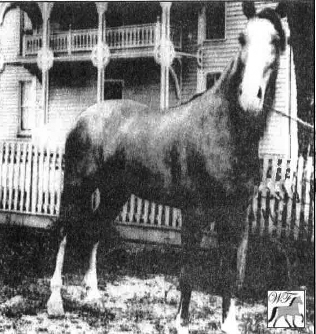 It is now among the greatest pleasures I
possess from the storehouse of memory to recall Roan Allen
standing, or in action, and to compare him with the best champions
of today. I trust the readers of THE TENNESSEE WALKING HORSE will
pardon my pride in saying that not one of those champions could
outclass him today. His sons, daughters and grandchildren have
produced almost 100 per cent of the acknowledged champions, and
they, in turn, have brought the highest prices for stallions,
mares, geldings brood mares and young things ever recorded in the
annals of our breed. Who would not feel very proud of having been
the breeder and owner of such a sire when his foals, owned by
others who state with genuine pride that this horse, mare or
stallion is by a son or grandson, or out of a mare by Roan Allen? It is now among the greatest pleasures I
possess from the storehouse of memory to recall Roan Allen
standing, or in action, and to compare him with the best champions
of today. I trust the readers of THE TENNESSEE WALKING HORSE will
pardon my pride in saying that not one of those champions could
outclass him today. His sons, daughters and grandchildren have
produced almost 100 per cent of the acknowledged champions, and
they, in turn, have brought the highest prices for stallions,
mares, geldings brood mares and young things ever recorded in the
annals of our breed. Who would not feel very proud of having been
the breeder and owner of such a sire when his foals, owned by
others who state with genuine pride that this horse, mare or
stallion is by a son or grandson, or out of a mare by Roan Allen?
Nothing is of more importance, of course,
than the blood and performance of the sire and dam. The most
colossal mistake in all my years of breeding horses was made the
day I sold Allan F-1 to
my good friend, Albert M. Dement, of Wartrace, Tennessee. Today,
these two stallions are a father-and-son combination that will
live on after I have answered the last roll call, to render their
strong influence, to produce the best light horse in the world for
pleasure or utility.
The story of
Allan F-1, written by my good friend, W.J. McGill, of
Shelbyville, Tennessee, in Volume I, of this publication, was most
interesting to me, as he is, of course, the sire of Roan Allen.
There is little that I could add to that story except to say that
Allan F-1 was as
easy-gaited a horse as any one ever rode. I rode him myself, and
so did my children and many neighbors. No stallion ever lived who
had a better disposition. His gaits in the trot, pace, flat or
running walk were perfect. He had a particular gliding gait under
saddle truly equal to the family rocking chair. He had perfect
style, a very high head, a natural, high tail, quick, very fine
hair, good flat bone and ample foot. Indeed, anyone today would
have to appraise him as a great horse, which he was.
I have always contended, and still
believe, that any great breeding stallion was backed through
several generations with outstanding dams that were truly
representative of that particular breed. This is doubly true of
Roan Allen through Allan
F-1, his sire, and Gertrude, the dam of Roan Allen. Gertrude was a
red roan, four stockings, bald face, 15 and a half hands, 1,100
lbs. Gertrude was the best flat-foot walker I ever saw. She was
fine, and the kind of mare you would select to be the dam of a
great horse. I bred Gertrude and also her dam, Ball II, which was
one of the best walking mares ever in Coffee County. Ball, her
dam, roan with white markings, was also truly a great walking
mare, very fast, with style, and never produced a foal that was
not a natural walker.
Thus, through inheritance, Roan Allan came
by his greatness in having a notable sire and through a list of
dams that were all a credit to the breed.
At three years of age, Roan Allen was 15-3
hands high. This was the exact size I liked, and after I measured
him, the standard was never placed on him again to my knowledge.
However, I never found fault with his size, conformation or
disposition, and his good bloodlines impress me more today than
they did when he died in August, 1930.
As a three-year-old, he served five mares,
and all foaled to the service. In this group was a great show
mare, owned by John Stevens, a sorrel mare, Mr. Stevens later bred
many mares to Roan Allen, and produced many of the greatest
walking horses of the time. After Roan Allen's colts began to
develop and the general public realized he was a great sire, mares
came from all over the adjoining counties to his court. The
blood-lines of these mares largely included Hal, Brooks, Bullet,
Stonewall and Donald breeding. These include almost all the dams
of the early foals of Roan Allen.
My friend, Ed Ward, of Flat Creek, Bedford
County, Tennessee, was among the first to appreciate the breeding
ability of Roan Allen, and bred his great show mare, Crickett to
him for several years, and produced truly good horses from this
mating.
As the get of Roan Allen developed to
three-, four-, five-, and six-year-olds, a great many people came
to buy them. Many of his best get were sold for plantation horses
in Mississippi, Arkansas and Louisiana to large planters.
Allow me to call attention here to a very
important fact concerning Roan Allen and his particular kind of
style that no other horse ever had, in my estimation. He had
something unusual in the easy manner in which he could show all of
his gaits. In addition, his manners were perfect; anyone could
handle him with ease.
I should mention Roan Allen's first
trainer, as there are many who have claimed that honor. The truth
is that I let Charlie Ashley, of Manchester, have him in the
summer, and he trained him and brought him back to my farm in
February as a four-year-old. Charlie taught him all the walking
gaits, and he was indeed a walking horse. Roan Allen could go more
gaits, and do them all more correctly, than any horse I have ever
heard of, or seen perform. His flat foot walk was strong and fast.
He could do the running walk, canter, fox-walk, fox-trot, and also
do a perfect square trot in harness. He had a great overstride of
from 35 to 40 inches in his running walk and would stay in form,
of course. He was as fast then as any of the speediest walkers of
this day. Truly, Roan Allen could do seven distinct gaits and was
so trained, and he knew the rider's cue for every gait.
Albert M. Dement showed Roan Allen two
seasons for me at the county fairs, and he was ridden during this
time mostly by Henry Davis, of Wartrace, Tennessee. French
Brantley, my son, also showed him at county fairs for three
seasons, and he won twice at the Tennessee State Fair against many
notable horses. He was defeated one time by
Hunter's Allen
F-10 at the State Fair. Later on that same season, Arthur Hoyle
showed Roan Allen at the Wartrace Fair and Horse Show with three
judges awarding the ribbons, and he defeated
Hunter's Allen on
this occasion.
Joe Crawford bred his famous mare, Dutch,
by Allan F-1, to Roan
Allen and produced a filly foal, named Little Dutch, which was one
of the greatest show mares of all time. Dutch, the dam, was also a
great show mare. I have always believed that Little Dutch was one
of the greatest walking mares I ever saw.
W.H. Davis would show Roan Allen in the
walking horse or "plantation" classes, as they were called then,
the combination classes, saddle and buggy, and then in the
five-gaited class, where he met some of the greatest horses of the
day. He defeated Roe's Chief, then owned by Tom Hayes of
Lynchburg, several times, and the good sportsmanship between Tom
and Henry often caused Tom to state, "No walking horse has a right
to defeat a gaited horse as good as old Chief." Of course, Roan
Allen did not defeat him often. However, you could vouch for a
good show every time they met in the gaited or fine harness
classes.
Some of the famous get of Roan Allen were:
Wilson's Allen,
who was out of the great mare Birdie Messick, a dapple grey, by
Allan F-1;
Merry Boy, roan,
white markings, out of Merry Legs
F-4, by Allan F-1;
Brantley's Roan Allen Jr., a light roan, out of a dam by Hal
Sumner F-7; Hal Allen, sorrel, out of a dam by
Hunter's Allen
F-10 and his full brother, Sam, chestnut; Hill's Allen, chestnut;
Major Bowes, chestnut; Sycamore Farm Allen, black; Dr. allen,
roan; Al Stone, bay roan. Roan allen sired more chestnuts or
light-colored sorrels than any other color.
The breed was unfortunate in losing Major
Bowes at eight or nine years old. He was a solid chestnut horse
and he probably would have developed into one of the greatest
breeders of the Allan family, a full brother to the great show
horse, Harvest Moon.
Wilson's Allen and
Merry Boy are double-grandsons of
Allan F-1. I was
never much of a trader, and when I was convinced of the breeding
ability of a stallion, I susually owned him up until death, as was
the case of Roan Allen.
When Roan Allen was coming six years old,
we had a horse show here in Manchester. There was a special prize
for the best lady driver and horse in the harness class. My
daughter, Carrie, then 16 or 17 years old, showed Roan Allen and
won. There was also another class for the best horse and chlld
rider, and Clyde Lee Manley, then seven years old and a son of Lee
Manley rode Roan Allen and won the class. Roan Allen was also
shown in the saddle horse class and won. He could show in more
different classes at the best shows in his day, and win more of
them, than any horse that ever lived.
Frankly, I always gave him credit for
having abundant brains, and I still consider him the smartest
horse, with the best disposition, of any horse I have ever known.
If we could recall all the show horses,
stallions, mares and geldings, sired by Roan Allen which were
exhibited throughout the years in Tennessee and elsewhere. I
believe his name would leas all the rest of the Tennessee Walking
Horse tribe. It gives me great pleasure as the breeder and owner
of Roan Allen, now F-38 in the stud books of the Breeder's
Association, to see his offspring met the best horses in the
country and win so many championship ribbons. Within the last
year, Wilson's Bullett, by Roan Allen, has been made a Foundation
Sire, F-65. Also the dam of Roan Allen, Gertrude, has been placed
on foundation, due to her great breeding ability in producing not
only Roan Allen, but other great horses. Her number is F-84. This
recognition, I feel, is justly merited and as the breeder of
Gertrude, I am glad that she has been so recognized.
In closing, let me urge all breeders of
The Tennessee Walking Horse to know something of their
blood-lines, and their producing ability for our required gaits.
Check the performance of sires and dams. That is the only true
measure we can have in reproduction. To the many owners of great
horses of our breed that carry the blood of Roan Allen, I extend
my congratulations and best wishes for having the blood of what I
will always believe to be the greatest sire that will ever be
recorded by our breed.
|