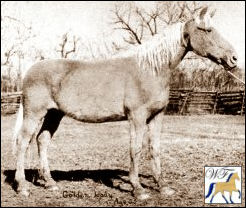
Golden Lady (TWHBEA #350031) was foaled in 1913. Her color is listed as "yellow," but her true color was gold champagne. Her markings showed "both hind stockings, bald (face), white mane and tail." Her sire was Eddie Hal (TWHBEA #F-14) and her dam was Ella Posten (TWHBEA #11380). Golden Lady produced ten foals: Golden Girl (gold champagne mare), Golden Sunshine (gold champagne stallion, gelded), Mary Lou Allen (chestnut sabino mare), Bright Allen (stallion registered as "roan," actually chestnut sabino), Yellow's Janie (mare registered as "roan," actually chestnut sabino), Jimmy Allen (chestnut sabino stallion), Chieftain (chestnut stallion), Easter Allen (chestnut stallion), Yellow Jacket (gold champagne). "...Golden Lady (#350031), foaled in 1913, is the oldest registered yellow horse, being the second yellow horse registered by the Association. Her breeder was J. D. Posten, Bunker Hill, Tennessee, and she was the property of B. C. Hunter and Son of Lewisburg, Tennessee when she was registered. She was the dam of eleven foals with the following three being yellow: Golden Girl (#350019), mare, foaled 1923, by Hunter's Allen F-10; Golden Sunshine (#F-44), stallion, foaled 1925, also by Hunter's Allen; and Yellow Jacket (#360141), stallion, foaled 1936. B. C. Hunter and Son were the breeders of all three....Golden Lady (#350031), foaled in 1913, is the oldest registered yellow horse, being the second yellow horse registered by the Association. Her breeder was J. D. Posten, Bunker Hill, Tennessee, and she was the property of B. C. Hunter and Son of Lewisburg, Tennessee when she was registered. She was the dam of eleven foals with the following three being yellow: Golden Girl (#350019), mare, foaled 1923, by Hunter's Allen F-10; Golden Sunshine (#F-44), stallion, foaled 1925, also by Hunter's Allen; and Yellow Jacket (#360141), stallion, foaled 1936. B. C. Hunter and Son were the breeders of all three. " - Origins of the Palomino Tennessee Walking Horse by Harold Dean Givens © Copyright 1991, Voice of the Tennessee Walking Horse, Lewisburg, Tennessee Reprinted with permission "My theory is that some of our very first yellow horses were champagnes. In fact and I can hear the pshaws of disbelief already I believe old Golden Lady #350031, foaled in 1913, and her three golden foals (Golden Sunshine F-44, Golden Girl #350019, and Yellow Jacket #360141) as well as many of her grand-get, including Barker's Moonbeam #380497, were actually champagnes. Golden Lady was owned throughout her breeding career by Burt Hunter of Lewisburg, Tennessee. Burt's daughter, Jean Hunter, remembers well her family's golden horses and described Golden Sunshine F-44 to me in vivid detail. "He was the most unusual color you've ever seen," she says. "You could put a gold dollar up against him and stand back in the sun, and you couldn't see the dollar. And he had white skin and yellow eyes. His mother, Golden Lady, was the same way." Golden Girl and Yellow Jacket had the same pale skin and eyes, Jean added." Champagne Shades by Liz Nutter © Copyright 1999, Voice of the Tennessee Walking Horse, Lewisburg, Tennessee Reprinted with permission from Liz Nutter
OFFSPRING
 Westwood Farms strong>- Locust Dale, Virginia 22948 - stephanie@westwoodfarms.net - 540-825-1300 |